Best High-Yield Savings Accounts in December 2025: Earn Up to 5.00% APY Safely
High-yield savings accounts are one of the easiest ways to make your money work harder without taking big risks. As of December 2025, some online banks are still paying up to 5.00% APY on savings, even though the Federal Reserve has already cut interest rates several times and is likely to cut again soon.
At the same time, many big banks such as Chase, Bank of America, Wells Fargo, Citi, and U.S. Bank pay around 0.01% APY on traditional savings accounts. That means keeping your cash in a low-rate account can cost you hundreds or even thousands of dollars over time.
This article explains, in simple terms:
- What a high-yield savings account (HYSA) is
- Why FDIC-insured online banks are safe
- Which banks are strong choices right now (Ally, Marcus, Capital One 360, Discover, Bread Financial, UFB Direct, SoFi, Varo, AdelFi, and more)
- How much more you can earn at 5.00% APY compared with the national average
- How to choose and open the best high-yield savings account for your needs
What Is a High-Yield Savings Account?
A high-yield savings account, often shortened to HYSA, is a savings account that pays a much higher interest rate than a regular savings account at a traditional bank.
The key features are:
- High APY (annual percentage yield): Many of the best high-yield savings accounts in December 2025 pay around 4.00%–5.00% APY.
- Compound interest: You earn interest on your balance, and then you earn interest on that interest. This helps your money grow over time.
- Online access: Most of the highest-paying accounts are online savings accounts, often from banks that do not have branches.
There is no strict official rule for when a savings account becomes “high-yield,” but you can think of it this way: if your bank is paying less than 1.00% APY, it is probably not a competitive high-yield savings account in today’s market.
Why High-Yield Savings Account Rates Are Changing in Late 2025
Savings rates are closely tied to the federal funds rate, which is the short-term interest rate controlled by the Federal Reserve (the Fed).
From 2022 through 2023, the Fed raised rates aggressively to fight inflation. During that time, savings account rates shot up. By early 2024, the best high-yield savings account rates reached about 5.55% APY, according to rate trackers like Investopedia.
By late 2024 and into 2025, the Fed began cutting rates as inflation slowed. The target range for the federal funds rate was reduced several times and now sits around 3.75%–4.00% after cuts in September and October 2025. Another cut is likely in December.
When the Fed cuts rates, banks usually lower high-yield savings account rates as well. For example, NerdWallet recorded Ally Bank’s online savings rate at about 3.80% APY in January 2025, dropping to about 3.30% APY by November and December 2025. Many other banks have made similar moves.
Even with these cuts, you can still find top savings account rates near 5.00% APY at certain online banks and smaller institutions, at least on limited balances or under special conditions. This makes December 2025 a good time to review where your savings is parked.
How Much More Can You Earn with a High-Yield Savings Account?
To see why a high-yield savings account matters, compare it with the national average savings rate, which is about 0.40% APY, and the rates at big brick-and-mortar banks, which are often 0.01% APY.
The table below shows what happens if you leave your money for one year at 0.40% APY versus 5.00% APY, with no extra deposits and no withdrawals.
| Starting Balance | 0.40% APY (National Average) | 5.00% APY (Top HYSA) | Extra Earnings with HYSA |
|---|---|---|---|
| $1,000 | $1,004 | $1,050 | $46 |
| $2,500 | $2,510 | $2,625 | $115 |
| $5,000 | $5,020 | $5,250 | $230 |
| $10,000 | $10,040 | $10,500 | $460 |
| $20,000 | $20,080 | $21,000 | $920 |
| $50,000 | $50,200 | $52,500 | $2,300 |
| $100,000 | $100,401 | $105,000 | $4,599 |
These numbers show why moving from a low-yield to a high-yield savings account can make a big difference, even though both options are very low risk.
If you also set up automatic monthly transfers from your checking account to your HYSA, your savings will grow even faster.
Are High-Yield Online Savings Accounts Safe?
High-yield savings accounts are considered very safe, as long as you choose a bank or credit union that is federally insured.
Most safe high-yield savings accounts in the U.S. are protected by one of these:
- FDIC (Federal Deposit Insurance Corporation) for banks
- NCUA (National Credit Union Administration) for credit unions
Both agencies insure deposits up to $250,000 per depositor, per institution, per ownership category. If an insured bank or credit union fails, your covered deposits are paid back by the government.
When you see “Member FDIC” after a bank’s name, that means your deposits in that bank (up to the limits) are protected. When you see “funds insured by FDIC” for a fintech app, it usually means the app is not a bank itself but uses a partner bank that is an FDIC member.
Some companies take this a step further:
- SoFi Bank uses the SoFi Insured Deposit Program to spread your deposits across several partner banks, allowing total FDIC coverage up to about $3 million if you meet their terms.
- Some savings accounts, like E*TRADE’s Premium Savings from Morgan Stanley Private Bank, use a deposit sweep program to offer up to $500,000 in FDIC insurance for a single account by using multiple banks behind the scenes.
Before you open a high-yield online savings account, always check how your money is insured and what the coverage limits are.
Best Safe, High-Yield Online Savings Accounts in December 2025
Rates change daily, but several FDIC-insured online banks appear again and again on lists from NerdWallet, Investopedia, Bankrate, and other trusted sites. Here is an overview of some top names and what they are known for. Always check the bank’s current APY and terms before you apply, because all savings rates are variable.
1. Ally Bank
Ally Bank is one of the most popular names in high-yield savings. It is an FDIC-insured online bank with no branch network.
Ally is known for:
- Consistently competitive high-yield savings account rates
- No monthly maintenance fees
- No minimum balance to open
- A strong mobile app and website
- Easy integration with Ally checking, CDs, and auto loans
Even when Ally is not at the very top APY in the country, it is often close and offers excellent overall service and features.
2. Marcus by Goldman Sachs
Marcus by Goldman Sachs is an online bank backed by Goldman Sachs Bank USA, Member FDIC.
Marcus is known for:
- High-yield online savings accounts with competitive APYs
- A strong lineup of CDs (certificates of deposit) with good rates
- No monthly fees and low minimums
- A simple, savings-focused experience
If you want an easy-to-use account for savings and CDs and like the reputation of Goldman Sachs, Marcus is a solid choice.
3. Capital One 360 Performance Savings
Capital One 360 offers its Performance Savings account as a high-yield online savings option.
Key features include:
- FDIC insurance through Capital One, N.A.
- No minimum balance and no monthly fee
- Competitive APYs on savings
- A popular app and website, plus access to Capital One checking and credit cards
Capital One 360 is a good option if you want to keep your checking, savings, and credit card at the same institution but still earn a high savings rate.
4. Discover Bank Online Savings
Discover Bank is another well-known online bank with FDIC insurance.
Its online savings account is known for:
- Competitive high-yield interest rates
- No monthly maintenance fees
- Good customer service
- A full range of other accounts, including checking, money market accounts, and CDs
If customer support and a strong brand are important to you, Discover Bank is worth a look.
5. Bread Financial (Bread Savings)
Bread Financial (formerly Bread Savings) is focused on saving and tends to chase the very top of the high-yield savings market.
What stands out:
- Often one of the absolute highest APYs available nationwide
- FDIC-insured banking
- Fewer extra products and features than a full-service bank
Bread Financial is most attractive if your main goal is pure savings growth and you are willing to open an account at a bank you may not already use.
6. UFB Direct
UFB Direct is less of a household name than Ally or Discover, but it frequently shows up at the top of best high-yield savings account rates lists.
It typically offers:
- Very high APYs on savings and sometimes on money market accounts
- FDIC insurance through its partner bank
- A focus on rate rather than a wide product menu
UFB Direct may be a good choice if you are comfortable with an online-only bank and are mainly interested in getting one of the top savings rates.
7. Varo Bank and AdelFi: 5.00% APY Examples
As of December 9, 2025, some of the best savings account rates tracked by Investopedia and NerdWallet include:
- Varo Bank, which offers around 5.00% APY on savings balances up to a certain limit (for example, up to $5,000) if you meet specific requirements.
- AdelFi, which also advertises a 5.00% APY savings account under its own conditions.
These banks show that 5.00% APY high-yield savings accounts still exist in December 2025, but they may:
- Apply only to a portion of your balance
- Require direct deposits, minimum activity, or other rules
- Reduce their APYs later if the Fed continues cutting rates
Always read the full terms before you rely on the promotional rate.
8. SoFi Checking and Savings
SoFi Bank, N.A. offers a combined Checking and Savings product.
Key points:
- FDIC-insured up to $250,000 at SoFi Bank, with extra coverage through the SoFi Insured Deposit Program that can bring total FDIC insurance to around $3 million for some customers
- High-yield savings rates, such as 3.60% APY or higher on savings balances, often with special boosts like 4.30% APY for SoFi Plus members or promotional periods
- No account, service, or maintenance fees
- Cash bonuses for setting up direct deposit, and access to 55,000+ Allpoint ATMs
SoFi is a good option if you want all-in-one online banking with a strong app, cash bonuses, and high-yield savings built into the same account.
9. Revolut High Yield Account (via Cross River Bank)
Revolut is a financial app, not a bank itself, but it offers high-yield savings accounts in the U.S. through Cross River Bank, Member FDIC.
Its savings features include:
- Different APYs depending on your plan
- High yields on “High Yield Accounts,” sometimes up to around 5.50% APY for Metal plan users
- A cap on how much can earn the top APY (for example, user deposits up to $10,000 in the high-yield bucket)
- FDIC insurance up to $250,000 through Cross River Bank
Revolut can work well if you already use the app and want a very high APY on a limited balance, but you should read the fine print and understand any subscription fees.
10. E*TRADE Premium Savings (Morgan Stanley Private Bank)
E*TRADE offers a Premium Savings Account from Morgan Stanley Private Bank, National Association, Member FDIC.
This account typically features:
- A competitive APY (for example, around 3.75% APY in late 2025)
- No minimum initial deposit and no monthly maintenance fee
- FDIC insurance through Morgan Stanley Private Bank
- A deposit sweep feature that, under certain conditions, can give individual savers up to $500,000 of FDIC coverage by spreading deposits across partner banks
E*TRADE Premium Savings is a strong choice if you want your high-yield savings account and your investment accounts under one roof.
How to Choose the Best High-Yield Savings Account for You
Several different banks can offer “the best high-yield savings account” depending on what you care about most.
To choose the right HYSA, look at:
- Interest rate and APY: Start with the APY, since your high-yield savings account rate determines how fast your money grows. Compare top APYs on sites like NerdWallet, Bankrate, Investopedia, and Forbes.
- Balance rules: Check whether the top APY applies to all balances or only up to a certain amount, such as $5,000 or $10,000.
- Fees and minimums: Look for accounts with no monthly maintenance fee and low or no minimum balance. Make sure you understand any fees that might apply, such as excess withdrawal fees or outgoing wire fees.
- Access and tools: A good high-yield online savings account should offer a reliable mobile app, mobile check deposit, and easy ACH transfers between your HYSA and your checking account. If you want ATM access, make sure the bank offers that through a network like Allpoint.
- Safety and insurance: Confirm that the institution is FDIC- or NCUA-insured and understand any additional insurance you might get from sweep programs.
- Reputation and support: Read reviews and ratings. Reliable customer service matters, especially when you are dealing with your emergency fund or large savings.
When Should You Use a HYSA Instead of Other Accounts?
High-yield savings accounts are usually best for:
- Emergency funds you need to be able to access quickly
- Short-term savings goals, like buying a car, going on a vacation, or building a house down payment
- Cash you want to keep safe but still earning a return above the national average savings rate
Here is a quick comparison with other common accounts:
| Account Type | Best Use Case | Typical Rate (late 2025) | Liquidity |
|---|---|---|---|
| High-yield savings (HYSA) | Emergency fund, short-term goals | Around 3.00%–5.00% APY | Easy access, some limits |
| Checking account | Everyday spending | 0%–0.50% APY (sometimes more) | Instant, full access |
| Money market account (MMA) | Savings with check/debit privileges | Similar to or below HYSAs | Easy, often with checks |
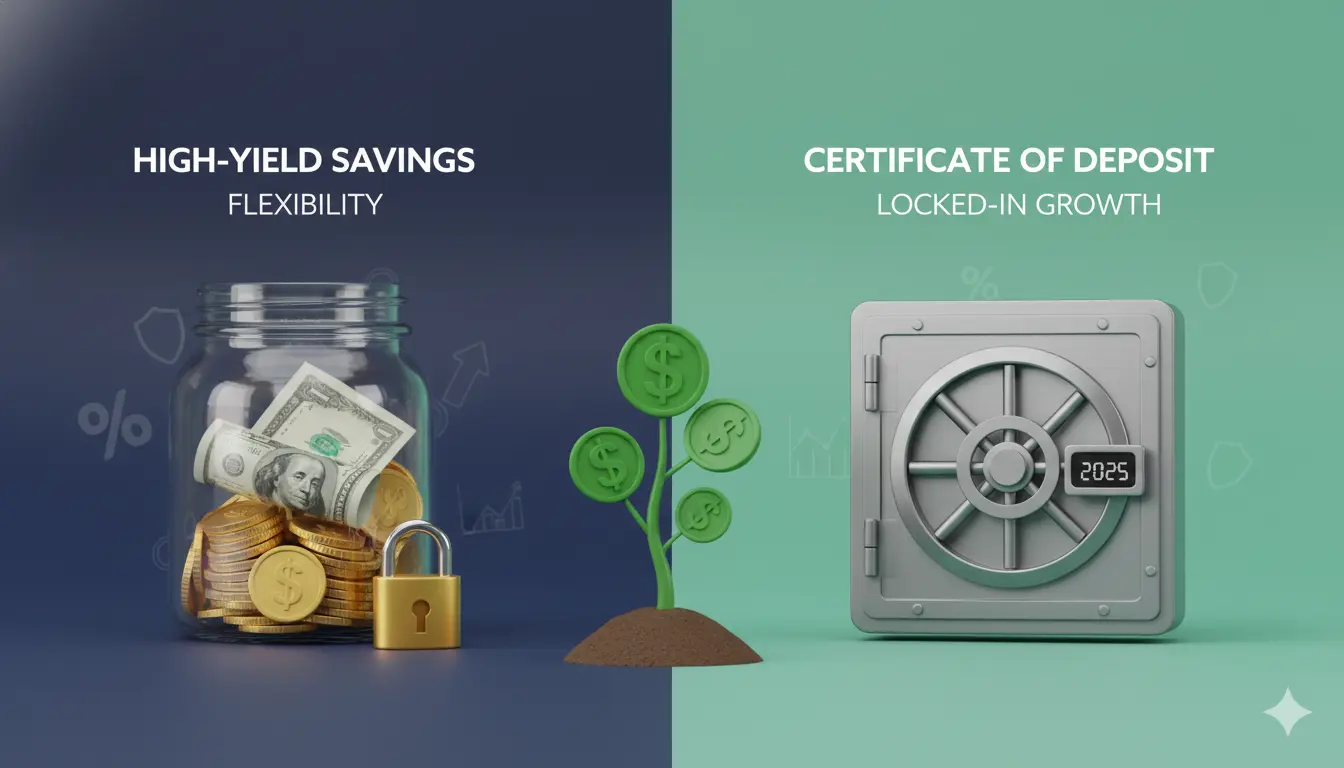
| Certificate of deposit (CD) | Medium- to long-term savings you won’t touch | Often higher than HYSAs, but fixed | Locked until maturity |
If you know you will not need certain funds for 1–5 years, a CD may give you a higher fixed rate than a HYSA. But for flexible money that you may need suddenly, a high-yield savings account is usually the best balance of safety, yield, and access.
How to Open a High-Yield Savings Account Online
Opening a high-yield savings account is usually simple and can be done in less than 15–20 minutes.
The process typically looks like this:
First, compare current rates for the best high-yield savings accounts on independent sites. Once you have chosen a bank, visit its website or download its app and select the high-yield savings account option.
Next, complete the online application form. You will enter personal details such as your name, address, date of birth, and Social Security number. The bank will use this information to confirm your identity and for tax reporting on your interest income.
The bank will then verify your identity. This may involve answering security questions or uploading a photo of a driver’s license or passport. After that, you will choose how to fund your new account. Most people use an external ACH transfer from another bank, but some institutions also allow funding by debit card, wire transfer, or mailed check.
Once you submit your application and funding request, it may take one to three business days for the money to move from your checking account to your new HYSA. During this time, keep enough cash in your checking account to cover your normal spending so you are not forced to move money back before the transfer finishes.
Finally, set up online banking and your mobile app login. Turn on security features such as two-factor authentication. If you want to grow your savings steadily, schedule an automatic monthly transfer from checking to savings.
Do You Pay Taxes on High-Yield Savings Account Interest?
Yes. The money you earn from a high-yield savings account is considered interest income, and it is taxable.
Each year, your bank or credit union will total the interest you received. If you earned at least $10 in interest, the institution will send you and the IRS a form called 1099-INT early in the next year. Even if you earned less than $10 and do not receive this form, the IRS expects you to report all interest income on your tax return.
The bank does not withhold taxes automatically on your HYSA interest. Instead, you include the interest on your tax return and pay any extra taxes that are due. If you have questions about how this works, it is wise to speak with a tax professional.
Final Tips to Maximize Your High-Yield Savings in 2025
High-yield savings accounts are one of the best low-risk tools you can use to build an emergency fund and reach short-term savings goals. In December 2025, 5.00% APY is still available at some institutions like Varo Bank and AdelFi, and many other FDIC-insured online banks such as Ally, Marcus, Capital One 360, Discover, Bread Financial, UFB Direct, SoFi, Revolut (via Cross River Bank), and E*TRADE remain strong options.
To get the most from your savings:
- Check what your current bank is paying. If it is close to 0.01% APY or even under 1.00% APY, consider moving to a high-yield online savings account.
- Compare APYs, fees, minimums, and requirements on trusted sites.
- Make sure your account is FDIC- or NCUA-insured and understand how much coverage you have.
- Use automatic transfers to build your balance without extra effort.
- Review your rate every few months, especially while the Federal Reserve is cutting rates, and be willing to move if your bank stops being competitive.
By taking a little time now to open one of the best high-yield savings accounts, you can keep your money safe, beat the national average savings rate, and earn a much better return on your cash in 2025 and beyond.