CD vs. High-Yield Savings Account: How to Choose the Right Option
If you’re trying to grow your savings safely, two of the most common choices are a high-yield savings account (HYSA) and a certificate of deposit (CD). People often ask, “Which is better, a CD or a high-yield savings account?”
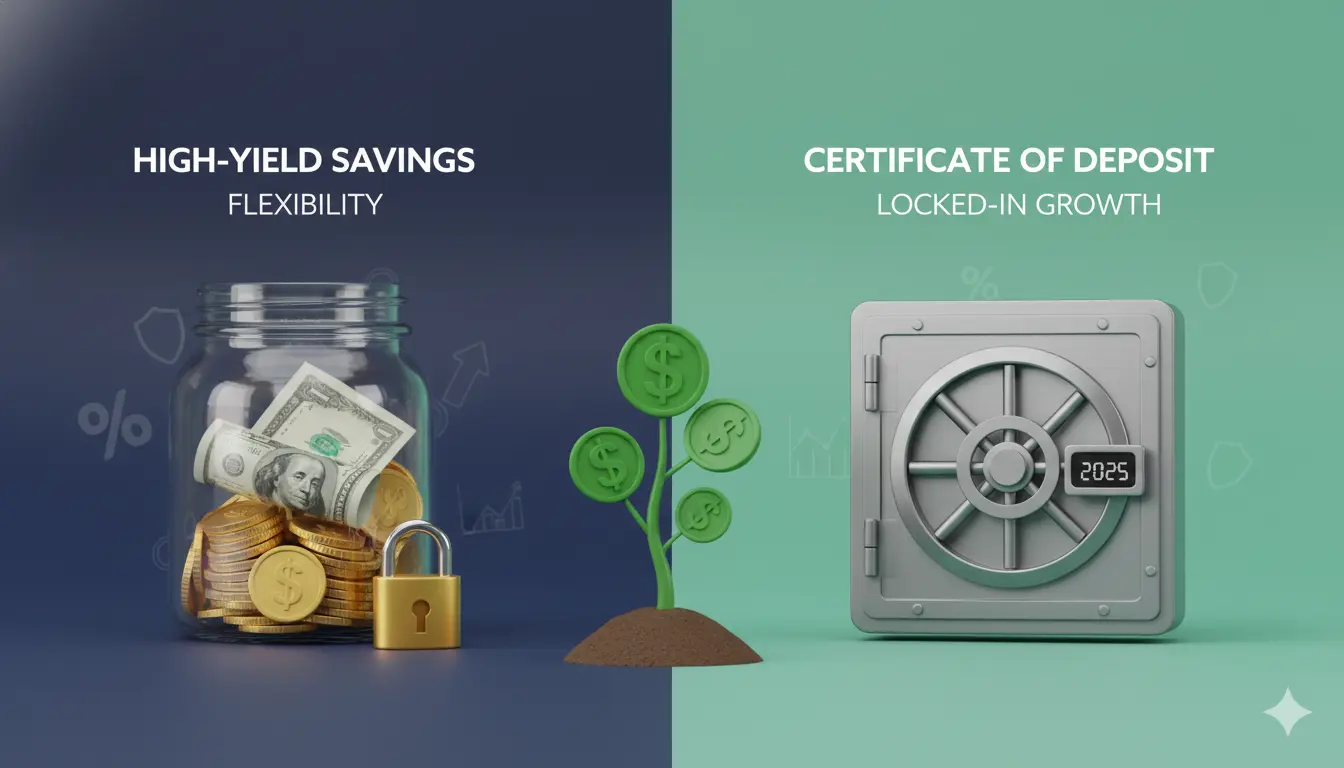
The honest answer is: neither one is always better. They are different tools for different jobs. A high-yield savings account gives you flexibility and easy access. A CD gives you stability and a fixed interest rate. The right choice depends on when you’ll need the money and how much access you want.
This guide explains, in simple language, what HYSAs and CDs are, how they work, their pros and cons, and how to pick the best one for your savings goals. We’ll also look at a popular strategy called a CD ladder, and how you can use both accounts together.
What Is a High-Yield Savings Account?
A high-yield savings account is a savings account that pays a higher interest rate than a normal savings account at a big traditional bank. These accounts are often offered by online banks and credit unions, which have lower costs and can pass some of those savings on to you through better rates.
When you keep money in a HYSA, the bank pays you interest, usually calculated daily and added to your account monthly. This interest is shown as an APY (Annual Percentage Yield), which tells you how much you’d earn in a year, including compounding.
Most high-yield savings accounts are:
- Easy to open online or through a mobile app
- FDIC- or NCUA-insured, which means your money is protected up to legal limits (usually $250,000 per depositor, per institution, per ownership type)
- Flexible, allowing you to move money in and out as needed
The key feature is that the interest rate is variable. It can go up when market interest rates rise and go down when they fall.
Pros and Cons of High-Yield Savings Accounts
A high-yield savings account is built for flexibility.
On the positive side, it gives you quick access to your money. If your car breaks down, you have a medical bill, or you lose your job, you can get to your savings without paying a penalty. That’s why many experts recommend keeping your emergency fund in a HYSA. You also can add money whenever you like, which makes it great for ongoing savings goals.
Because HYSAs usually pay much more interest than regular savings accounts, your money doesn’t just sit there. It grows faster, but still without the risk that comes with the stock market.
There are trade-offs. Since the rate is variable, the bank can lower it. If the economy changes or interest rates drop, your HYSA APY might go down too. At times, the best CD rates at the same bank can be higher than the HYSA rate, especially for longer terms. Some banks may limit the number of withdrawals per month or require you to move money to a checking account before you can spend it, which can take a day or two.
Still, if you want liquidity (easy access) and low risk, a high-yield savings account is hard to beat.
What Is a Certificate of Deposit (CD)?
A certificate of deposit, or CD, is another low-risk way to grow your money. With a CD, you agree to leave a certain amount of money in the account for a set period of time, known as the term. Common CD terms include 3 months, 6 months, 1 year, 2 years, and 5 years.
In return for locking in your money, the bank offers you a fixed interest rate that usually stays the same until the CD matures. At the end of the term, you get back your initial deposit plus interest.
CDs can be opened:
- Directly through a bank or credit union (these are usually FDIC- or NCUA-insured)
- Through an investment brokerage as a brokered CD
Some CDs are “callable,” which means the bank can choose to close them early and return your money, usually if interest rates move in a way that makes the CD less favorable to them. Callable CDs often pay higher rates, but you lose some control over how long the CD will last.
Pros and Cons of Certificates of Deposit
The main strength of a CD is stability. When you open one, you lock in a fixed interest rate. This gives you a guaranteed return as long as you keep the CD until it matures. If market interest rates fall after you open your CD, you keep earning the higher rate you locked in. For many savers, this peace of mind is very appealing.
CDs also often pay higher APYs than high-yield savings accounts at the same bank, especially for longer terms. That can make a real difference over a few years if you are saving a larger amount for a specific goal.
However, CDs are much less flexible than HYSAs. If you need your money before the maturity date, you will usually face an early withdrawal penalty, which might cost you some or all of the interest you have earned. With brokered CDs, if you sell early, you may get less than your original deposit back if interest rates have risen. Also, you usually make just one deposit into a CD. You can’t keep adding money to the same CD over time.
Because of this, CDs are not a good place for an emergency fund. They work better when you know you won’t need the money for a while.
CD vs High-Yield Savings Account: Key Differences
The table below shows the main differences between a CD and a high-yield savings account:
| Feature | High-Yield Savings Account (HYSA) | Certificate of Deposit (CD) |
|---|---|---|
| Interest rate type | Variable (can go up or down) | Fixed for the full term |
| Access to money | Can withdraw anytime (some limits may apply) | Best to leave until maturity; penalties for early withdrawal |
| Typical use | Emergency fund, short-term savings, ongoing deposits | Specific future goals with known dates |
| Ability to add money | Yes, you can deposit anytime | Usually one initial deposit only |
| Risk level | Low, often FDIC-/NCUA-insured | Low, often FDIC-/NCUA-insured |
| Best thing about it | Flexibility and liquidity | Guaranteed, predictable return |
Both are considered safe, low-risk savings options, but they are designed for different purposes.
When a High-Yield Savings Account Makes More Sense
A high-yield savings account is usually the better choice when access is your top priority.
If you’re building an emergency fund, a HYSA is ideal. Financial planners often suggest saving three to six months of living expenses. You want this money where you can reach it quickly if something goes wrong, without worrying about penalties or selling anything.
A HYSA is also good for short-term goals, like saving for:
- A trip later this year
- Holiday gifts
- A new phone or laptop
- A small home project
Because you can add money over time, it works well if you are saving a bit from each paycheck. You don’t have to decide on a fixed term like you would with a CD. And if a better rate appears at another bank, you can move your money without paying a penalty.
In short, choose a high-yield savings account when you:
- Want high liquidity
- Are not sure exactly when you’ll need the money
- Are still adding to your savings regularly
When a CD Is the Better Choice
A CD becomes attractive when you have a clear goal and timeline and you won’t need the money early.
Some good examples include:
- Saving for a down payment on a house in two or three years
- Putting money aside for college tuition due next year
- Planning a large purchase, such as a car or a wedding, at a specific time
In these cases, a CD lets you match the term to your goal. For instance, if you know you’ll need the money in 24 months, you might choose a 2-year CD. You lock in a fixed rate, often higher than the HYSA rate, and you don’t have to think about it again.
A CD can also be useful if you believe that interest rates may fall in the future. Locking in a good rate now protects you from lower rates later.
You should pick a certificate of deposit when you:
- Have a specific future date when you’ll need the money
- Can afford to leave the money untouched until then
- Prefer a guaranteed return over flexibility
Using a CD Ladder for Better Rates and Access
One way to get some of the benefits of CDs without giving up too much access is to build a CD ladder. This is a strategy where you divide your money into several CDs with different maturity dates.
For example, if you have $10,000 you want to keep safe but growing, you might do something like this:
- $2,500 in a 6 month CD
- $2,500 in a 12 month CD
- $2,500 in a 24 month CD
Every six months, one of the CDs matures. At that point, you can either use the cash or roll it into a new longer-term CD. Over time, you’ll end up with several CDs that have higher long-term rates, but you’ll also have one CD maturing at regular intervals, giving you periodic access to part of your money.
A CD ladder can be helpful if you:
- Want to earn higher CD rates
- Still want some money to come available regularly
- Worry about locking everything into a single long-term CD
How to Decide: A Simple Three-Step Framework
If you’re still unsure whether to choose a CD or a high-yield savings account, you can walk through three simple questions.
1. What is your time frame?
If you think you’ll need the money within a year, or you just don’t know, a HYSA is usually safer. If your goal is one to five years away and you know the date, a CD or CD ladder can work well.
2. How important is access to your money?
If you might need the cash at any time, even for an emergency, you want liquidity—so a HYSA is better. If you are sure you won’t need it early, you can consider a CD.
3. Do you want a fixed rate or are you okay with a changing rate?
If you like the idea of a fixed interest rate and a guaranteed return, choose a CD. If you prefer more flexibility and don’t mind a variable rate, pick a HYSA.
Your answers will usually point you clearly in one direction—or toward a mix of both.
Using Both: The Best of Both Worlds
You don’t have to choose only one account type. In fact, many people get the best results by using both a high-yield savings account and CDs.
A common setup looks like this:
- Keep your emergency fund and any money you might need soon in a high-yield savings account. This gives you fast, penalty-free access.
- Put extra savings for specific future goals into CDs or a CD ladder. This helps you lock in higher fixed returns on money you won’t need for a while.
This combined strategy lets you enjoy:
- Liquidity for surprises
- Stability and higher fixed rates for planned goals
- Low risk overall, with both accounts often protected by FDIC or NCUA insurance
Final Thoughts
When comparing a CD vs high-yield savings account, remember that you’re not looking for one perfect product for everyone. You’re matching the right account to the right purpose.
- Choose a high-yield savings account for emergency funds, short-term goals, and flexible access
- Choose a certificate of deposit for specific future purchases and when you want a guaranteed, fixed rate.
- Consider a CD ladder if you want better returns but still want some money to come available on a regular schedule.
- Use both together to balance liquidity and growth.
By understanding how CDs and high-yield savings accounts work, you can build a simple, low-risk savings plan that fits your life and helps your money grow steadily over time.